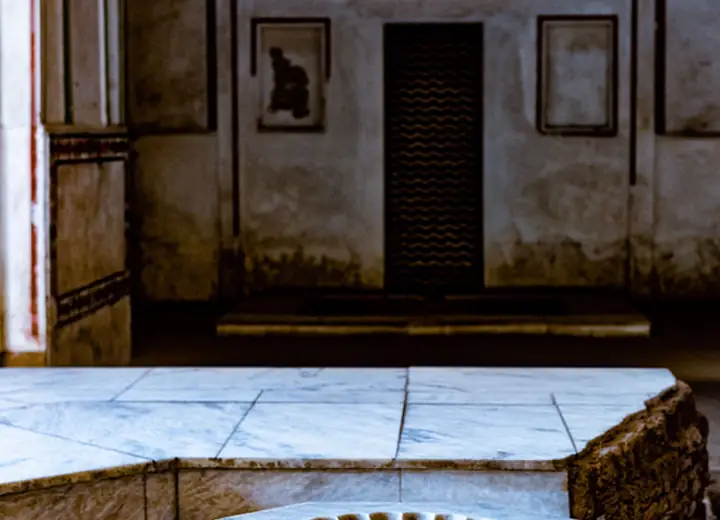
The Chini Mahal is a ruined palace within Daulatabad Fort whose name, the China Palace, comes from the glazed tiles that once covered it. After the Mughal conquest of the Deccan it was used as a prison, and it is best remembered as the place where Abul Hasan Tana Shah, the last Qutb Shahi sultan of Golconda, is said to have been held until his death in 1699. Today it survives as a long, weathered hall on the path up the fort.
A palace of coloured tiles
The word chini in this sense refers to glazed ceramic work, the kind of bright blue and white tiling associated with the Persian world. Palaces and mosques across the Deccan sultanates used such tiles to show wealth and taste, and the Chini Mahal was clearly one of the finer residences inside the fort.
Most accounts connect the building with the Nizam Shahi period, when the sultans of Ahilyanagar (Ahmednagar) held Daulatabad. Its exact date and original owner are not firmly recorded, so it is wise to treat any precise story you hear on site with some caution. What is certain is that it stood in the inner part of the fortress, behind the defences of the lower city and close to the main route to the summit.
Very little of the tile work survives. With patience and good light you may notice a few coloured fragments clinging to the walls, and they help you imagine how the building must once have glowed against the black basalt of the hill.
From palace to prison
When the Mughals took control of Daulatabad in the seventeenth century, the fort became an important state prison. Its single guarded entrance, steep cliffs and deep moat made escape almost impossible, which is exactly what a jailer wants.
The most famous prisoner linked to the Chini Mahal is Abul Hasan Qutb Shah, better known by his popular title Tana Shah. He was the last ruler of the Golconda Sultanate, in what is now Telangana. In 1687, after a long siege, Aurangzeb's forces captured Golconda and Abul Hasan was taken prisoner. He was sent to Daulatabad and spent roughly twelve years in captivity there, dying in 1699. With his death the Qutb Shahi dynasty came to an end.
Tradition places his confinement in the Chini Mahal. Historians note that the specific building is not always documented, but the association is old and strong, and it is the story local guides will tell you.
Tana Shah: the man behind the name
Abul Hasan is remembered warmly in Hyderabad as a cultured ruler and a patron of the arts. His reign also saw the rise of the brothers Madanna and Akkanna, powerful ministers who ran the kingdom's finances and who were killed in the turmoil before the fall of Golconda.
His end was quiet. After his death he was buried in a modest grave at Khuldabad, within the shrine complex of the Sufi saint Shah Raju Qattal. It is a striking thought that the last sultan of one of India's richest kingdoms lies in a small town only a short drive from the fort where he was held, in the same valley where Aurangzeb himself was later buried.
Finding the Chini Mahal today
The Chini Mahal lies in the inner fort, beyond the Chand Minar and the Kala Kot gates, before you reach the moat and the dark tunnel known as the Andheri. It is signposted along the main path, and most visitors pass it on their way up.
Nearby, on a bastion, is the large cannon known as the Mendha Tope, named for the ram's head on its muzzle. The cannon and the palace make a natural pair to explore together, and the bastion gives good views down over the lower fort and across to the Chand Minar.
- Allow twenty to thirty minutes for the Chini Mahal and the cannon bastion.
- Treat the structure gently. Parts of it are fragile, so stay on the paths and avoid climbing the walls.
- Carry water. There is little shade in this part of the fort by late morning.
- Early morning or late afternoon light shows the remaining tile fragments best.
Why it is worth pausing here
Many visitors hurry past the Chini Mahal on their way to the summit. It is worth slowing down. Few ruins in the Deccan tell such a clear story of how fortunes turned: a pleasure palace of coloured tiles became a cell for a defeated king, inside a fortress that itself had passed from the Yadavas to the Delhi sultans, the Bahmanis, the Nizam Shahis and the Mughals.
Standing here, you can connect the dots across the region, from Golconda in the east to the tombs at Khuldabad just up the road.
If you are staying at Hiranya, the fort is about a kilometre away, so an unhurried morning visit is easy to fit in. Our team is happy to help you combine it with Khuldabad, where Tana Shah's story quietly ends.