In 1327 the Delhi Sultan Muhammad bin Tughluq made the Deccan fortress city of Devagiri his second capital, renamed it Daulatabad, and ordered much of Delhi's ruling class to move there. Within about eight years, by 1335, he had allowed or ordered a return to Delhi. The plan failed because of the huge human cost of the journey, the difficulty of governing the north from the south, and rebellions that drew the sultan's attention elsewhere. Yet it changed the Deccan for centuries.
Why Daulatabad?
Devagiri had been the capital of the Yadava kingdom until it was brought under the Delhi Sultanate in the early fourteenth century. By the time Muhammad bin Tughluq came to the throne in 1325, the sultanate's reach extended deep into southern India, and holding it together from Delhi was a real challenge.
Daulatabad, meaning the abode of wealth, had several attractions. It sat closer to the centre of the empire as it then stood. Its hill fortress was among the strongest in India. And moving the court south put some distance between the capital and the threat of Mongol raids from the north-west. Historians still debate which reason weighed most with the sultan, and it was probably a combination.
How the move unfolded
The move was not simply a transfer of offices. Contemporary writers describe the sultan ordering nobles, officials, soldiers, religious scholars, Sufis and their households to relocate. A road was laid out between the two cities, with trees planted along it and halting places at regular intervals.
The distance was more than a thousand kilometres, through heat and difficult country. Despite the arrangements, many people died on the way. The chronicler Ziauddin Barani, who wrote at the Tughluq court, described Delhi as left almost empty. Modern historians generally regard his account as exaggerated: the ordinary population of Delhi was probably not moved wholesale, and the migration mainly affected the elite and those connected to the court.
Why it failed
Several problems came together.
- The human cost was high, and resentment among the uprooted nobility and scholars was deep.
- Governing northern India, the heartland of the sultanate, from the Deccan proved impractical.
- Rebellions broke out in distant provinces, including Ma'bar in the far south and Bengal in the east, stretching the sultan's resources.
- Disease and famine in these years added to the strain.
By around 1335 the sultan turned back towards Delhi, and many of those who had been forced south were now permitted, or pressed, to return. This second journey brought its own hardships. The episode has since become shorthand for a brilliant but impatient ruler whose grand ideas outran their execution, alongside his equally famous experiment with token currency.
What it left behind
The most lasting result was unintended. Not everyone went back north. A community of officers, soldiers and families from Delhi stayed on in the Deccan, bringing with them their language, customs and ways of governing.
Within little more than a decade, some of these settlers rose against Delhi's authority. In 1347 a new independent kingdom, the Bahmani Sultanate, was proclaimed at Daulatabad under Alauddin Hasan Bahman Shah, who is often known as Hasan Gangu. The Bahmanis soon moved their capital south to Gulbarga, but their state, and the sultanates that grew from it, dominated the Deccan for the next two centuries. The Chand Minar at Daulatabad, raised in 1445, is one of their monuments.
Scholars also link this period of migration to the spread in the Deccan of the language that later developed as Dakhni, a southern form of the Hindavi speech of Delhi.
Seeing the Tughluq story on the ground
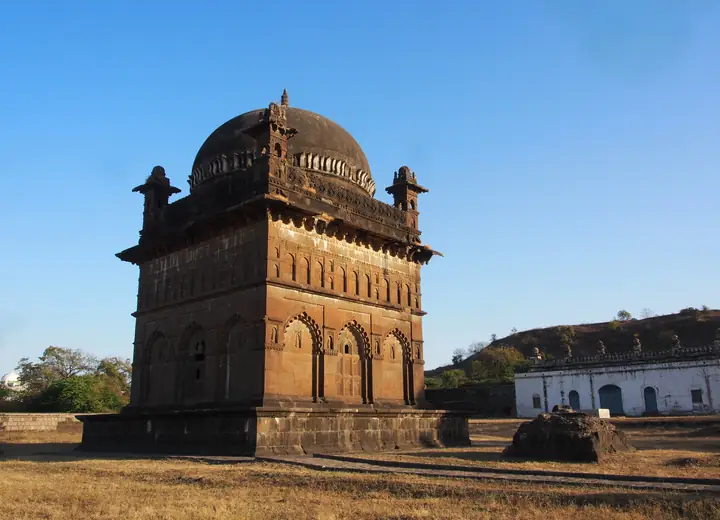
At Daulatabad today, the Tughluq capital is less visible than you might expect. The fortress on the hill is largely the work of the Yadavas, reshaped and extended by later rulers. The lower city walls and several of the reservoirs and water channels around it belong to the long sultanate period, and Mombatta Lake, beside which Hiranya sits, is itself a medieval reservoir linked to the old water system that supplied the city.
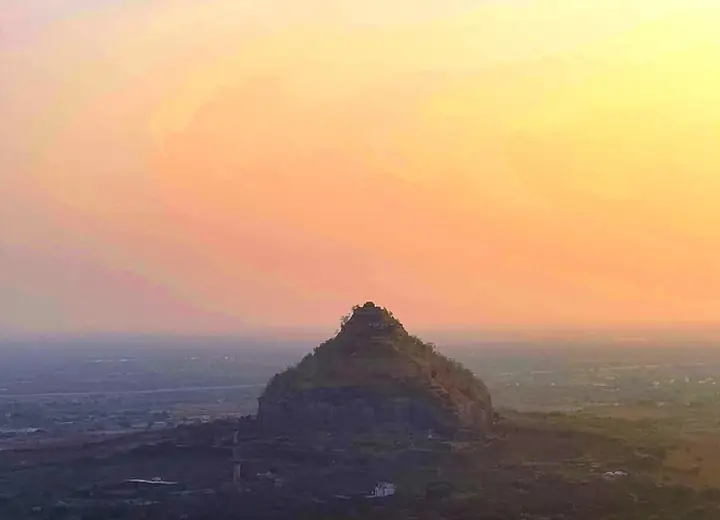
A good way to feel the scale of the story is to climb to the summit of the fort and look out over the plains. It was across this land that the court of Delhi arrived, and across it again that most of them left.
Staying at Hiranya puts you about a kilometre from the fort, on the banks of that old reservoir. Many guests like to read up on the Tughluq years over breakfast and then walk the fort the same morning, when the history feels closest.