
The Chand Minar is a 63-metre tower standing just inside the outer walls of Daulatabad Fort, near Chhatrapati Sambhajinagar (Aurangabad). It was raised in 1445, during the reign of the Bahmani Sultan Alauddin Ahmad Shah, as a monument to victory. Visitors cannot climb it today, but it is one of the first things you see after passing through the fort's gates, and it is best admired from the ground and from the heights of the fort above.
Why the tower was built
By the fifteenth century Daulatabad had already changed hands several times. The Yadava city of Devagiri had fallen to the Delhi Sultanate, been renamed Daulatabad by Muhammad bin Tughluq, and then passed to the Bahmani Sultanate, which was proclaimed here in 1347 before moving its capital south to Gulbarga and later Bidar.
The Bahmani sultans kept Daulatabad as an important provincial stronghold on their northern frontier. The Chand Minar was commissioned in 1445 during Alauddin Ahmad Shah's reign, and it is generally described as a victory tower, marking the sultan's military successes. Its inspiration was clearly the great Qutb Minar of Delhi, which every ruler with ambitions in India knew well.
The name Chand Minar, the Moon Tower, is a popular one. You will hear different explanations for it from guides, and none is certain, so it is simplest to enjoy the name for its poetry.
Architecture: what to look for
The minar rises in four storeys, each marked by a projecting balcony. The balconies rest on carved stone brackets, a detail borrowed from the region's older temple and palace building traditions rather than from Persia. Inside, the tower is said to hold 24 small chambers, arranged around a spiral stair.
Look at the base, where a small mosque or prayer hall sits against the tower. Its surfaces once carried glazed tiles in Persian blue, and traces of this colourful work can still be picked out if you look closely in good light. Tile work of this kind was a mark of prestige and of contact with the wider Persian-speaking world that the Deccan sultanates belonged to.
As you study the shaft, notice how it tapers gently from storey to storey. From a distance this makes the tower look even taller than it is, and at 63 metres it was already one of the tallest structures in the Deccan. It remains visible from almost every part of the fort, and from the road as you approach Daulatabad.
The tower in its setting
The Chand Minar does not stand alone. Across the path is a large pillared hall that served as a mosque in the sultanate period and is known today as the Bharat Mata temple. Its columns are older, reused from earlier structures, which tells you something of the layered history of the site. Nearby is the Hathi Haud, a great stone tank that stored water for the lower city.
Taken together, these buildings show how the lower fort worked as a small city: a place of worship, a public reservoir, and a tower announcing to every arriving traveller who held power here. Pausing among them for ten minutes before you begin the climb is time well spent.
How to see the Chand Minar today
The minar is protected by the Archaeological Survey of India and sits within the Daulatabad Fort complex, so a small ASI entry ticket for the fort also gives you access to the grounds around the tower. The interior staircase is closed to visitors, and has been for many years, so plan to enjoy it from outside.
A few suggestions for a good visit:
- Come in the first hour after opening, when the low sun lights the tower and the tile work is easier to see.
- Walk slowly around the base rather than photographing it only from the path; the brackets and balcony details reward a closer look.
- Photograph it again from higher up the fort, near the Chini Mahal and later from the summit, where the tower stands out against the plains.
- Carry water and wear comfortable shoes, since most visitors combine the minar with the full climb of the fort.
If you are interested in photography, late afternoon also works well, as the tower catches a warm light against the dark rock of the fort hill behind it. Weekday mornings are generally quieter than weekends and public holidays.
Linking it to the rest of Daulatabad
The Chand Minar is best understood as one chapter in a long story. The hill fortress above it was begun by the Yadavas, extended under the Delhi and Bahmani sultans, and later held by the Nizam Shahis of Ahilyanagar (Ahmednagar) and the Mughals. Each group left its own mark, and the minar is the most elegant of the Bahmani contributions.
If you have time, visit Khuldabad a short drive away, where several figures connected with Daulatabad are buried, and Ellora beyond it. Together they make a satisfying day of Deccan history.
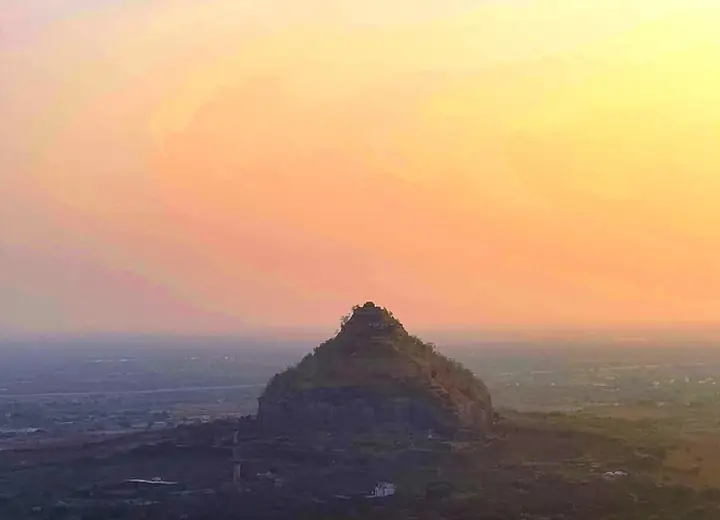
Hiranya sits about a kilometre from Daulatabad Fort, on the banks of the old Mombatta Lake, so you can be at the gates when they open and back for a late breakfast. From our sunset trek to the ridge behind the resort, you can often pick out the Chand Minar against the evening sky.