The best stargazing months in the Deccan run from about October to May, when the monsoon clouds have cleared and the air is dry. The three most reliable meteor showers are the Quadrantids around 3 to 4 January, the Perseids around 12 to 13 August and the Geminids around 13 to 14 December. The Milky Way's bright core is best seen before dawn from roughly March to May, and in the early evening in September and October once the rains retreat.
Meteor showers happen when Earth passes through a stream of dust left behind by a comet or asteroid. They repeat on roughly the same dates every year, although the exact peak can shift by a day, so it is worth checking an astronomy website or app shortly before you go. The other factor is the Moon. A bright Moon near the peak washes out all but the brightest meteors, so look up the Moon's phase for the year you are planning.
For the darkest skies, choose a night close to new Moon, avoid the glow of the city and give your eyes at least twenty minutes to adjust. Red torchlight preserves night vision; phone screens do not.
January to March: Quadrantids and winter stars
The year opens with the Quadrantids, which peak around 3 to 4 January. They can be strong, but the peak is short, lasting only a few hours, so timing matters. The best viewing is usually in the hours before dawn, looking towards the north-east.
Winter evenings are also the season of Orion, easy to find by the three stars of its belt. Follow the belt down to Sirius, the brightest star in the night sky, and up to the orange Aldebaran and the Pleiades cluster, a small misty dipper-shaped group visible to the naked eye. Cold, clear January nights in the Deccan are often among the sharpest of the year.
April to June: the Milky Way before dawn
From about March, the galactic core, the brightest part of the Milky Way, rises in the early morning hours. By April and May it is well placed before dawn, stretching up from the southern horizon through Scorpius and Sagittarius. Scorpius, with its red heart star Antares, is one of the few constellations that genuinely looks like its name.
Two smaller showers fall in this season: the Lyrids around 22 April and the Eta Aquariids in early May, the latter linked to Halley's Comet and best seen before dawn. Pre-monsoon haze and dust can soften the sky by late May, so earlier is usually better.
July to September: monsoon breaks and the Perseids
The monsoon makes this the hardest season for stargazing in Maharashtra. The Perseids, one of the most popular showers worldwide, peak around 12 to 13 August, right in the middle of the rains. On many years clouds will hide them, but a clear break in the weather can reward patient watchers with bright, fast meteors, many leaving glowing trails.
By late September, as the rains ease, the evening sky improves quickly. The Milky Way now arches overhead after dark, and the Summer Triangle of Vega, Deneb and Altair is high in the west.
October to December: Orionids, Leonids and Geminids
Autumn and early winter are the Deccan's prime stargazing months. The Orionids, another shower linked to Halley's Comet, peak around 21 October. The Leonids follow around 17 November; in most years they are modest, but they are famous for occasional storms.
The highlight is the Geminids, peaking around 13 to 14 December. Unusually, they come from an asteroid, 3200 Phaethon, rather than a comet, and they are one of the richest showers of the year, with slow, bright meteors that are often visible from mid-evening. Wrap up warmly, lie back on a mat or reclining chair and look at a broad area of sky, not directly at the radiant.
Planets through the year
Planets do not follow a fixed annual calendar, because each moves around the Sun at its own pace. Venus appears as a brilliant morning or evening star for months at a time, Jupiter and Saturn are well placed for several months each year, and Mars is best when it comes closest to Earth, roughly every two years. A free sky-chart app will show you what is up on any given night. Even a small pair of binoculars reveals Jupiter's four largest moons as tiny points of light, and a modest telescope shows Saturn's rings.
Stargazing from Hiranya
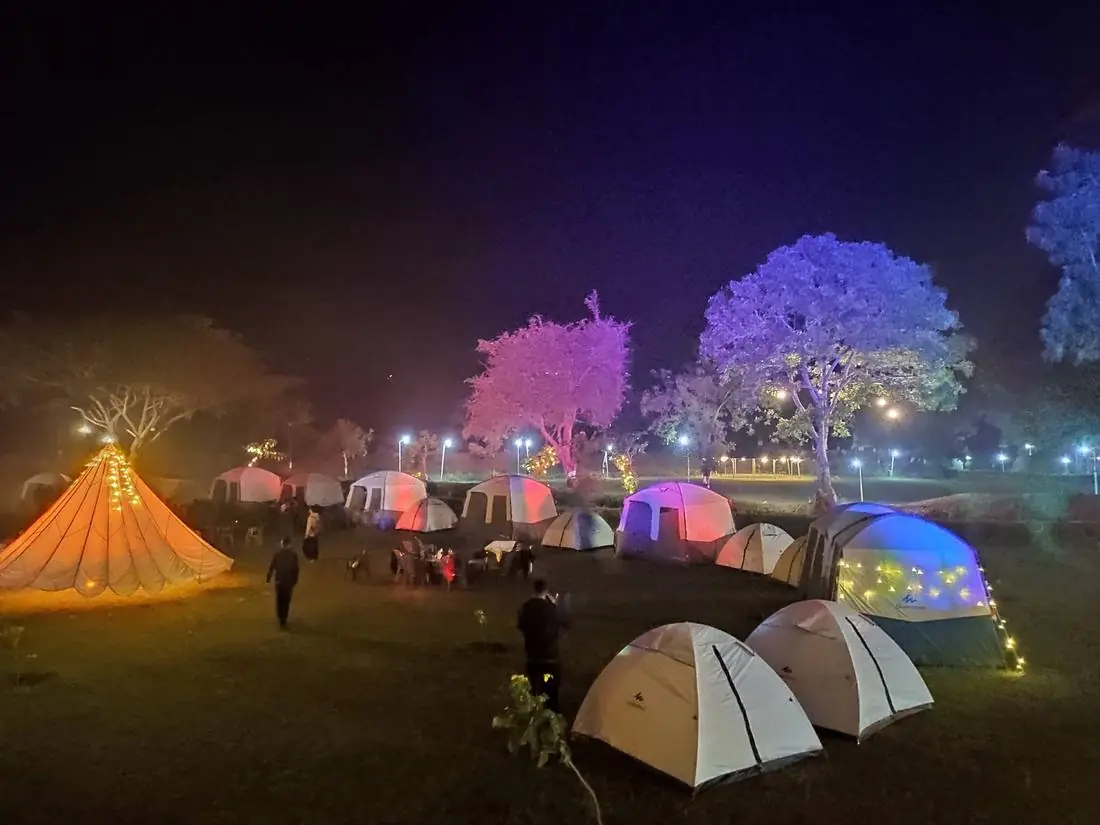
Hiranya is far enough from the city to enjoy low light pollution, and on clear nights the Milky Way is often visible over Mombatta Lake. A bonfire and stargazing evening is one of our quieter experiences; if a shower peak falls during your stay, let us know and we will help you find a comfortable, dark spot to watch.