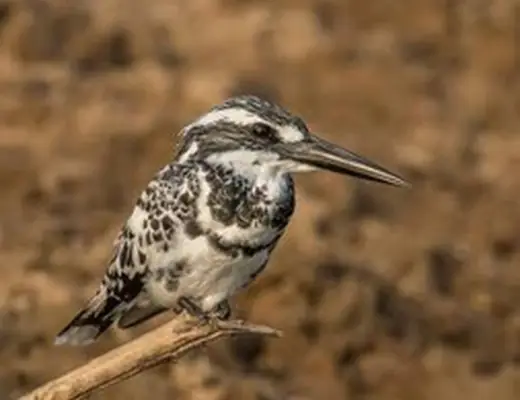
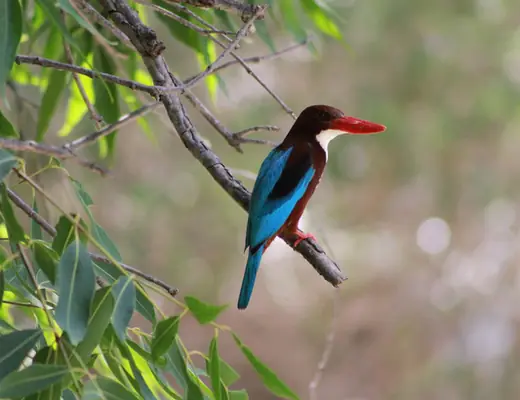
Three kingfishers are commonly seen around the lakes and streams of the Deccan: the White-throated Kingfisher, the Pied Kingfisher and the Common Kingfisher. The quickest way to tell them apart is colour and hunting style. The White-throated is a large chocolate-and-blue bird with a red bill and a white bib; the Pied is black and white and hovers over water; the Common is small, bright blue above and orange below, and fishes from a low perch.
The White-throated Kingfisher
This is the kingfisher most visitors notice first, partly because it is bold and partly because it does not need water at all. You may find it on a wire above a dry field, a fence post or a bare branch, scanning the ground for insects, lizards, frogs and even small rodents, as well as fish.
Look for a deep chocolate-brown head and underparts, a brilliant turquoise-blue back and wings, and a clean white patch on the throat and chest. The large, dagger-like bill is coral red. In flight, white patches on the wings flash clearly, which helps when the bird is flying away from you.
Its call is a loud, rattling laugh, often given from a high perch or in flight. If you hear that sound near fields or water, scan the tops of trees, poles and wires.
The Pied Kingfisher
The Pied Kingfisher is a bird of open water: lakes, reservoirs and slow rivers. It is the easiest of the three to identify, because it is entirely black and white, with a shaggy crest and a strong black bill. Males show two black bands across the chest, while females have a single band, often broken in the middle.
Its hunting style is its signature. Rather than waiting on a perch, it hovers in the air over open water, wings beating fast and body held almost upright, then drops headfirst into the lake. This lets it fish well away from the shore, where other kingfishers cannot reach. Pairs and small groups are common, and they chatter with sharp, high notes.
The Common Kingfisher
The smallest of the three, the Common Kingfisher is only a little larger than a sparrow, and it is easy to overlook until it flashes past low over the water like a blue spark. Its upperparts are an electric blue-green, with a brighter blue stripe down the back, and its underparts and cheeks are rich orange. It has a white throat and a white patch on the side of the neck.
Watch for a small bird sitting very still on a reed, twig or rock just above the water, bobbing its head as it judges the position of a fish. The dive is quick and direct. Its call is a thin, high whistle, usually given in flight. Females can be told by an orange-red lower half of the bill, while males have an all-dark bill.
Telling them apart at a glance
When you are standing by a lake and a kingfisher appears, these quick checks usually settle it:
- Black and white, hovering over open water: Pied Kingfisher.
- Large, chocolate brown with a white bib and red bill, often far from water: White-throated Kingfisher.
- Tiny, blue above and orange below, perched low over the water: Common Kingfisher.
- Loud laughing rattle from a high perch: most likely White-throated.
- Thin high whistle from a bird zipping low over the water: most likely Common.
Size is harder to judge in the field, but if you see two species together the difference is obvious. The Common Kingfisher looks almost dainty beside the others.
Where and when to watch them
All three are resident in the Deccan and can be seen through the year, though water levels influence where they gather. After the monsoon, when lakes and tanks are full, Pied Kingfishers spread across open water and Common Kingfishers find plenty of perches along flooded edges. In the dry months, look for them wherever water remains.
Early morning and late afternoon are the most active periods. Sit quietly near a stretch of shoreline with low branches or reeds, and give it time. Kingfishers often return to favourite perches, so once you have seen one, it is worth waiting to see it again. A lens of moderate length is enough for photographs if you move slowly and let the bird settle.
Kingfishers at Mombatta Lake
All three kingfishers are among the birds seen on the banks of Mombatta Lake around Hiranya, and the dawn hours by the water are a good time to look for them. If you would like to learn more, a birdwatching or photography session can be arranged on request, or you can simply take your tea to the lakeside and watch.