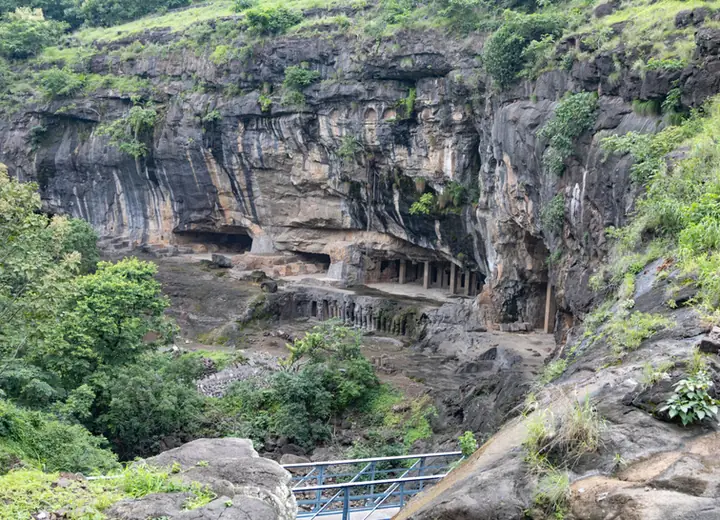
The Pitalkhora Caves are a group of 14 early Buddhist rock-cut caves in a ravine of the Satmala hills, about 20 km from the town of Kannad and roughly 40 km from Ellora. Work began around the third century BCE, which places them among the earliest Buddhist caves in western India, older than most of Ajanta. They are quiet, atmospheric and seldom crowded, and reward anyone with a real interest in the history of the Deccan's cave art.
A short history
Pitalkhora belongs to the first great wave of Buddhist cave building in the Deccan, when monastic communities began carving halls and dwellings into the basalt cliffs along trade routes. Inscriptions at the site range from around the third century BCE to the third or fourth centuries CE, showing that it was in use for a long time.
Some scholars have linked Pitalkhora with Petrigala, a place mentioned by the Greek geographer Ptolemy, and with Pitangalya, named in a Buddhist text as a site whose monks and donors made gifts. These identifications are suggestive rather than certain, but they hint at a place known well beyond the region.
Like Ajanta, the caves were eventually abandoned and largely forgotten, before being noticed again in the nineteenth century. Some of their finest sculptures are now in museums, including the National Museum in New Delhi.
What to see
The caves are arranged in two groups along the sides of the ravine, one of ten caves and one of four. Most are viharas, the living and study spaces of monks, while four are chaityas, or prayer halls.
- The main chaitya hall: an apsidal hall with a rock-cut stupa at the end and rows of octagonal pillars. Faint traces of paintings survive on the pillars and walls, some from a later period when the site was revisited.
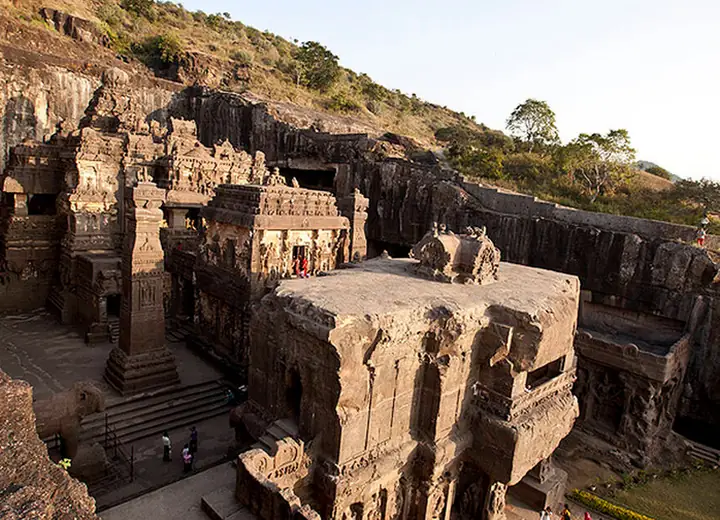
- The elephant frieze: at the base of one of the main caves, a row of carved elephants appears to carry the building on their backs, an idea that later reached its grandest expression at the Kailasa temple at Ellora.
- The guardian figures: near an entrance stands a carved soldier, one of two that once guarded the doorway, a rare early image of a Deccan warrior.
- The Gaja Lakshmi: a damaged but still recognisable image of the goddess bathed by elephants.
- The water channels: look for the cisterns and rock-cut drains that carried rainwater through the site, an early example of careful water harvesting.
The name Pitalkhora is often explained as meaning the brass ravine, perhaps from the colour of the rock, though this is a popular explanation rather than a proven one.
How to get there
Pitalkhora lies north-west of Ellora. From Daulatabad, the usual route is to drive towards Kannad and then take smaller roads into the hills towards the caves. Allow roughly an hour and a half to two hours each way from Hiranya, depending on the road and traffic. Local roads can be narrow, so a car with a driver who knows the area is the easiest option.
From the parking area, the caves are reached by a steep flight of steps down into the ravine, passing a waterfall that flows after the rains. The climb back up is the hardest part of the visit, so pace yourself.
The site is managed by the Archaeological Survey of India, and a small ASI entry ticket may apply. Facilities nearby are very limited.
Tips for your visit
- Go between August and January, when the ravine is green and the weather is comfortable. The monsoon waterfall is lovely, but steps can be slippery just after heavy rain.
- Start early to avoid the midday heat on the walk back up.
- Carry plenty of water and some food; there is little available at the site.
- Wear shoes with good grip, and carry a torch for the darker interiors.
- The surrounding hills border the Gautala Autramghat Wildlife Sanctuary, so keep an eye out for birds and langurs.
- Combine it with a quieter day rather than trying to fit it in with Ellora and Daulatabad at once.
Why visit Pitalkhora
After the grandeur of Ellora, Pitalkhora offers something different: a small, early monastery in a wild setting, where you can see ideas that would later flower elsewhere in the region. It is also one of the few places near Chhatrapati Sambhajinagar where you may have ancient caves almost to yourself.
Hiranya makes a comfortable base for a day trip to Pitalkhora, and our team can help you plan the route and arrange transport. Coming back to a swim and a quiet dinner by the lake is a gentle end to a long day in the hills.