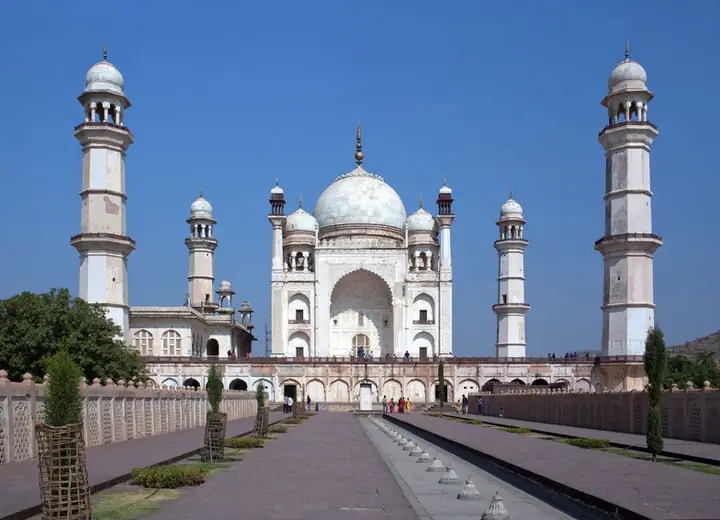
In 1660, Prince Azam Shah commissioned a memorial for his mother Dilras Banu Begum — the first wife of Emperor Aurangzeb, who died in childbirth. The result was Bibi Ka Maqbara, a white marble and lime plaster complex that so clearly recalls the Taj Mahal that it has been called the Taj of the Deccan ever since.
The similarities are unmistakeable: a central domed mausoleum in white, approached through a formal garden with reflecting pools, flanked by four slender minarets. But the differences are equally instructive. While the Taj Mahal is clad entirely in white marble from base to spire, Bibi Ka Maqbara uses marble only for the lower portion — the upper section and surrounding structures use lime plaster. This is not a failure of ambition but a reflection of Aurangzeb's restrictions on imperial spending; the Emperor reportedly limited the amount of marble that could be used for his wife's memorial.
The mausoleum is nevertheless a refined and beautiful building. The marble panels of the lower section are carved with characteristic Mughal floral tracery of high quality, and the proportions of the central dome and minarets are well judged. The octagonal chamber within contains the raised platform (rauza) above the actual tomb, with both covered by intricate perforated marble screens (jali).
The best time to visit is either at sunrise, when the marble turns gold in the early light, or in the evening, when the complex is illuminated until 10pm — making it one of the only historical monuments in India where evening visits are genuinely worthwhile.
Entry is by a small ASI ticket. From Hiranya Resort, Bibi Ka Maqbara is about 20km — roughly 35 minutes by taxi.