The conventional wisdom about visiting Ellora and Aurangabad is: go between October and February. This is good advice for those who want clear skies and comfortable temperatures. But it misses something extraordinary.
During the monsoon — roughly July through mid-September — the Deccan Plateau transforms. The parched, brown landscape that stretches away from Ellora in the dry months turns electric green overnight. The rocky hillsides sprout hundreds of temporary waterfalls that thunder for three months and then vanish completely. The ancient dams and lakes fill to capacity, their spillways roaring. The caves themselves, carved from the dark basalt that absorbs and holds moisture, glow with an almost phosphorescent quality in the diffuse monsoon light.
At Hiranya Resort, the monsoon is our most dramatic season. The waterfall inside the property — inactive for most of the year — comes roaring to life in August and September, falling directly through the property into the lake below. The 150-year-old mango tree produces fruit. The langur population seems to multiply as juveniles born in spring reach their playful phase. The lake fills and turns jade green against the forested hills.
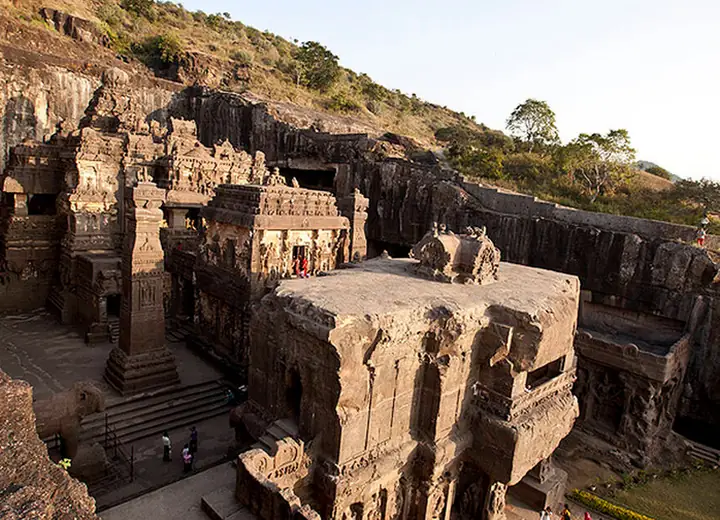
The Ellora Caves themselves are extraordinary in the rain. The massive Kailasa Temple, wet and dark, with water streaming off its spire and fog drifting through the courtyard, acquires a mystical quality that clear-day photographs simply cannot capture. The stone shows its true colour — deep, warm grey-black with orange and green lichen — rather than the bleached pale that dry heat creates.
A practical note: Some roads in the area can flood briefly after heavy rain, and evening activities at the resort move indoors during heavy showers. But the tradeoff — genuine wilderness nature at its most alive — is, for many of our guests, the single most memorable experience of their stay.