The food to look for around Ellora is Marathwada's everyday farm cooking: jowar or bajra bhakri, a pot of pithla, a fierce green chilli thecha, dry zunka, simple varan-bhaat and, on festive days, sweet puran poli. It is plain, honest food built from millets, gram flour, lentils and chillies, and it tastes best eaten slowly, with your hands, somewhere near a field.
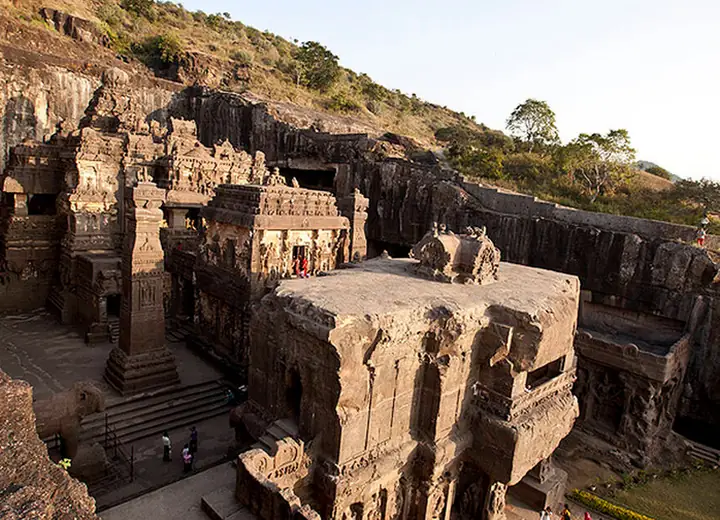
The city of Chhatrapati Sambhajinagar (Aurangabad) is famous for its Mughal-era dishes, but step a few kilometres out towards Ellora, Khuldabad and the villages around Daulatabad and the table changes completely. This is the food of people who work the land, designed to be filling, simple to make from what the farm gives, and quick to put together at the end of a long day.
Bhakri: the bread of the Deccan
Bhakri is an unleavened flatbread, usually made from jowar (sorghum) and sometimes from bajra (pearl millet) or a mix. The dough has no gluten, so it cannot be rolled like a chapati; instead, cooks pat it out between their palms or on a board with quick, practised taps. It goes onto a hot tawa, gets a splash of water on top, and is then puffed over the open flame.
A good jowar bhakri is soft inside with a slightly crisp, speckled outside. It is naturally gluten-free and sits well in the stomach, which is why farmers have eaten it at every meal for generations. Tear off a piece, scoop up whatever is beside it, and do not be shy about asking for another.
Pithla and zunka: two ways with gram flour
Pithla is the comfort food of rural Maharashtra. Besan (gram flour) is whisked with water and stirred into a tempering of oil, mustard seeds, garlic, green chillies, onions and turmeric until it thickens into a soft, pourable porridge. Some households make it loose, others almost thick enough to slice. Pithla and bhakri together are so common a pairing that the phrase "pithla-bhakri" is shorthand for a simple home meal.
Zunka is pithla's drier cousin. The gram flour is added dry, or with very little water, to plenty of onions and chillies and cooked until it becomes crumbly and slightly toasted. Where pithla is soothing, zunka is savoury and a little crunchy, and it travels well, which is why it was long a staple for people eating in the fields.
Thecha: handle with care
Thecha is a coarse, pounded condiment of green chillies (sometimes red), garlic, a little salt and often roasted peanuts or coriander. Traditionally it is crushed in a stone mortar or on a flat grinding stone, which gives it a rough texture rather than a smooth paste.
It is very hot. The usual way to eat it is a tiny smear on a piece of bhakri, perhaps alongside a raw onion and a little curd to cool things down. If you are not used to chilli, taste a pinhead first. Many visitors end up asking for a little extra to take home.
Varan-bhaat and puran poli
Varan-bhaat is the gentlest dish on this list: plain boiled toor dal, lightly salted and flavoured with turmeric and sometimes a pinch of asafoetida, poured over steamed rice with a spoon of ghee and a squeeze of lemon. It is what Maharashtrian families feed children, the sick and anyone who needs something kind after a long journey. It is also traditionally among the first things served at festive meals.
Puran poli is the celebration dish. A soft wheat dough is stuffed with puran, a sweet filling of chana dal cooked with jaggery and scented with cardamom and sometimes nutmeg, then rolled thin and roasted with ghee. It is made for festivals such as Holi and Gudi Padwa and at weddings, and is often eaten with katachi amti, a thin, spiced broth made from the water in which the dal was cooked, or simply with warm milk or more ghee.
How and where to try it
Village-style meals are served at dhabas along the Ellora and Khuldabad roads, and at small eateries in the old parts of the city. A few tips help you get the most out of them:
- Eat with your right hand and tear bhakri with your fingers; cutlery is fine to ask for, but it is not how the food is meant to be enjoyed.
- Ask for dishes to be made less spicy if you need to. Cooks are used to the request.
- Look out for seasonal extras such as methi or shepu bhaji in the cooler months, and fresh curd or buttermilk to balance the heat.
- Jowar bhakri is at its best straight off the flame, so eat it quickly rather than letting it stack up.
- Many of these dishes are naturally vegetarian, and Jain versions without onion and garlic can often be made if you ask.
If you visit between November and January, the Hurda season adds another layer: tender green jowar roasted over embers and eaten with chutneys, a direct link between the fields and the plate.
A taste of the land
What makes this food memorable is not complexity but context. Bhakri made from grain grown down the road, thecha pounded by hand, and a pot of pithla shared around one table tell you more about Marathwada than any restaurant menu can.
At Hiranya, our waterfall-side restaurant cooks everything fresh to order, often with vegetables from the farm, and our team is always happy to talk about local dishes and point you towards good village food nearby. After a morning at Ellora, it is a lovely way to understand the region a little better.