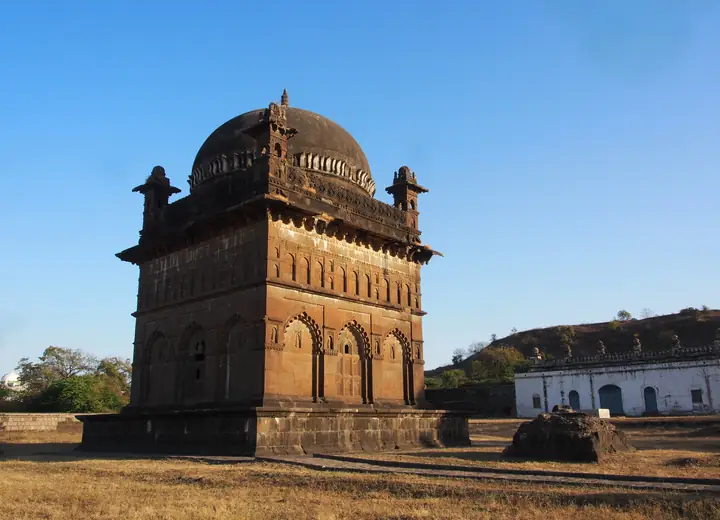
Khuldabad is the kind of place that takes most travellers completely by surprise. Expecting a small town near Ellora, they find instead a landscape dense with medieval dargahs, walled gardens, ancient trees, and an atmosphere of profound stillness that feels genuinely otherworldly.
The town's name — Khuldabad, abode of the eternal — reflects its status as one of the most sacred burial grounds in the Deccan. For several centuries after its founding in the 14th century, being buried in Khuldabad was considered a supreme honour, and great men competed for plots of land near the tombs of its most beloved saints.
AURANGZEB'S TOMB: The most visited site and the most startling. Mughal Emperor Aurangzeb, who ruled over the largest empire in the world for 49 years and commanded wealth beyond imagination, requested that his tomb be the simplest possible structure — an open-air grave, unfenced, with no monument, covered only by the sky. His tomb today is exactly that: a small marble slab, surrounded by a few stone posts, shaded by trees. The contrast with the magnificent Taj Mahal built by his father could not be more complete. It is one of the most moving memorials in India precisely because of its deliberate humility.
DARGAH OF ZAINUDDIN SHIRAZI: The principal spiritual figure of Khuldabad, a Sufi saint whose shrine draws pilgrims from the Deccan and beyond. The dargah complex contains beautifully maintained gardens, a mosque, and accommodation for visiting pilgrims.
THE ROBE OF THE PROPHET: Perhaps the most extraordinary claim of Khuldabad is that the dargah of Burhanuddin Gharib holds a garment said to have belonged to the Prophet Muhammad, shown to devotees during Eid celebrations. Whether or not one accepts this provenance, the reverence with which it is treated is a remarkable window into the depth of Sufi devotional culture in the Deccan.
Khuldabad is 8km from Hiranya Resort and is best visited in the late afternoon when the light softens and the dargah gardens become particularly beautiful.