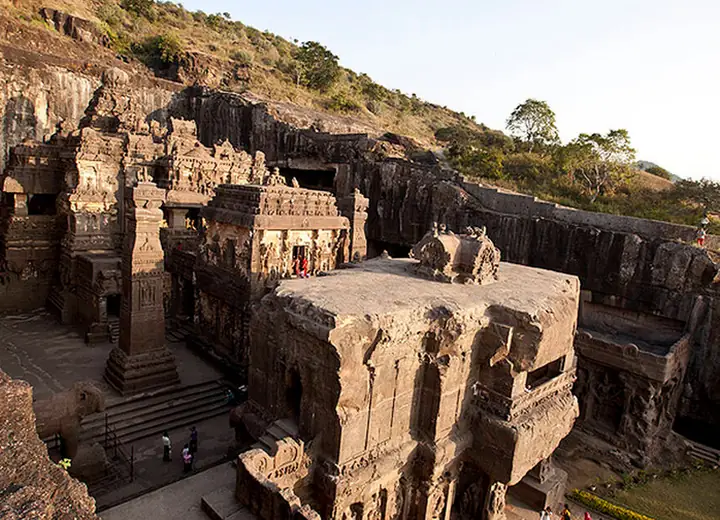
Beyond the Kailasa temple, the four Hindu caves most worth your time at Ellora are Cave 14 (Ravan ki Khai), Cave 15 (Dashavatara), Cave 21 (Rameshwar) and Cave 29 (Dhumar Lena). Each has a distinct character, from the elegant river goddesses of Rameshwar to the vast pillared hall of Dhumar Lena, and together they show how Hindu cave architecture developed at Ellora over roughly two centuries. All four can be seen comfortably in two to three hours alongside Kailasa.
How the Hindu caves fit together
Ellora's 34 caves fall into three groups: Buddhist caves 1 to 12 to the south, Hindu caves 13 to 29 in the centre, and Jain caves 30 to 34 to the north. The Hindu caves span a long period, broadly from the sixth to the eighth centuries, with the great Kailasa (Cave 16) as their crowning work.
A simple plan is to see Caves 14 and 15, which sit just south of Kailasa, before or after the great temple, and then walk north to Cave 21 and, finally, Cave 29, which lies near a seasonal waterfall at the northern end of the Hindu group. Remember that Ellora is closed on Tuesdays.
Cave 15: Dashavatara
The Dashavatara is a two-storey cave approached through a courtyard with a free-standing pavilion. Its plan resembles a Buddhist monastery, and it may have been begun as one before being completed as a Hindu shrine. In the court is an inscription of the Rashtrakuta king Dantidurga, dating to the mid-eighth century, which makes this one of the few caves at Ellora with a direct royal record.
Climb to the upper hall, which is the real reward. Large sculpted panels line the walls, showing forms of both Shiva and Vishnu. Look for Narasimha, the man-lion, tearing apart the demon Hiranyakashipu, one of the most dramatic sculptures at Ellora, and for Shiva emerging from a flaming pillar of light while Brahma and Vishnu search for its ends. Despite the cave's name, which refers to the ten incarnations of Vishnu, Shaiva themes are just as prominent.
Cave 14: Ravan ki Khai
Right beside Dashavatara, Cave 14 is a single-storey hall with a shrine at the back. Its side walls are lined with large panels that make it a kind of sculpture gallery. Among them are Durga slaying the buffalo demon, Vishnu in several forms, Lakshmi bathed by elephants, and Ravana trying to lift Mount Kailasa.
Look too for the Saptamatrikas, the seven mother goddesses, carved in a row with their attendant figures. The cave is often quieter than its neighbour, so you may be able to study the panels without hurry.
Cave 21: Rameshwar
Rameshwar is one of the earliest Hindu caves at Ellora, generally dated to the late sixth century, and one of the most beautiful. It is small, and that is part of its charm: every surface is finely worked.
At the entrance stand the river goddesses Ganga and Yamuna, graceful figures who welcome the visitor and symbolise purification before entering the shrine. Inside, the panels include the marriage of Shiva and Parvati, the Saptamatrikas with Ganesha, and a dancing Shiva. Look closely at the brackets on the pillars, where slender female figures lean out beneath foliage. Many visitors consider this the most refined carving at Ellora.
Cave 29: Dhumar Lena
Cave 29 is one of the largest caves on the site and among the earliest Hindu excavations here. Its plan is cross-shaped, with entrances on three sides, and it recalls the great cave temple at Elephanta near Mumbai.
Stone lions guard the stairways. Inside, huge panels show Ravana shaking Mount Kailasa, Shiva destroying the demon Andhaka, and the marriage of Shiva and Parvati. In the centre stands a square shrine with a linga, guarded by tall doorkeepers. The scale is quite different from Rameshwar, and the play of light through the three openings is memorable.
The cave sits close to a waterfall that flows during the monsoon, and on a wet day the sound of the water adds a great deal to the atmosphere. The rock around it can be slippery then, so take care.
Tips for visiting
- Start early; the central Hindu caves get busy by mid-morning, especially at weekends.
- Carry a small torch for the inner shrines, and water, as the walk between caves can be hot.
- Flash photography is not permitted inside the caves.
- A guide helps you read the panels; at the least, carry a list of the main stories.
- Wear shoes that slip on and off easily, as you may be asked to remove them at shrines.
Hiranya is about 8 km from Ellora, roughly 15 minutes by road, so you can split the site over two visits rather than rushing it in one day. We can arrange a guided Ellora tour, or an early-morning cycle ride there for guests who enjoy starting the day on two wheels.