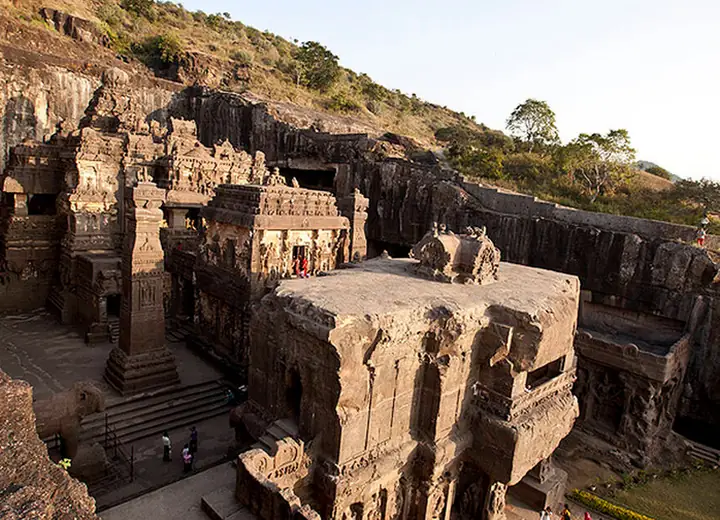
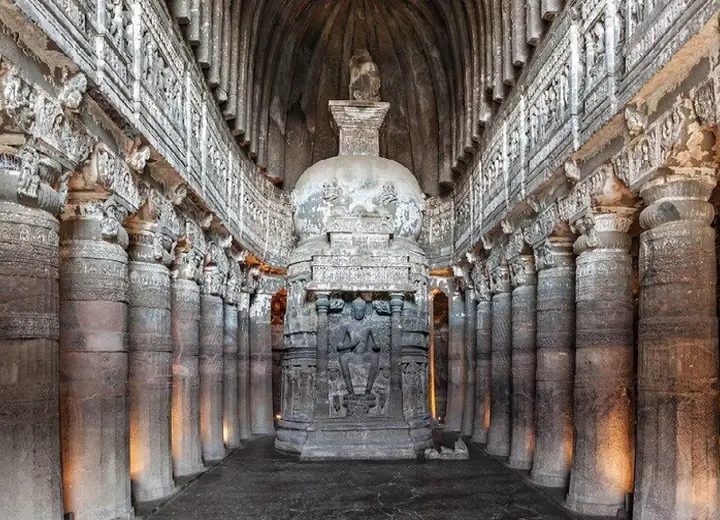
The most famous paintings at Ajanta are in Caves 1, 2, 16 and 17. The celebrated bodhisattvas Padmapani and Vajrapani are in Cave 1, on the back wall of the main hall on either side of the doorway leading to the Buddha shrine: Padmapani, holding a lotus, is on the left and Vajrapani, holding a thunderbolt, on the right. Give your eyes a minute to adjust to the low light, stand back from the wall, and the figures emerge with remarkable presence.
A quick orientation
Ajanta's caves are cut into a horseshoe-shaped cliff above the Waghur river, about 120 km from Hiranya, roughly two and a half hours by road. They were created in two main phases: an early group from around the second and first centuries BCE, and a later, much larger group from the fifth century CE. Most of the paintings visitors come to see belong to the later phase.
Vehicles stop at the car park near Fardapur, and buses take visitors on to the foot of the caves. Ajanta is closed on Mondays. The caves are numbered along the cliff, not by age, so you walk from Cave 1 towards the far end.
Cave 1: Padmapani and Vajrapani
Cave 1 is a large monastery hall with a Buddha shrine at the back, and it is the richest painted cave on the site. Walk straight through the hall towards the shrine. On the back wall, flanking the antechamber doorway, you will find the two great bodhisattvas.
Padmapani, the bearer of the lotus, stands with his head gently inclined and a blue lotus in his hand, his expression calm and compassionate. Vajrapani, on the other side, wears an elaborate crown and holds the vajra. Look at the modelling of the faces and the fine jewellery: the painters used shading to give a sense of volume, which is one reason these images are so admired.
Before you leave, look at the side walls, where Jataka stories, tales of the Buddha's previous lives, fill the surface with courtly scenes, palaces and crowds.
Cave 2: ceilings and stories
Next door, Cave 2 is best known for its painted ceilings, covered in medallions, flowers, fruit and small figures. Tilt your head back and let your eyes travel slowly across them; the patterns are astonishingly varied.
On the walls, look for scenes connected with the birth of the Buddha, including his mother Maya's dream of a white elephant. A small shrine dedicated to Hariti, a protective goddess of children, is also found here.
Caves 16 and 17: the storytellers
Cave 16 contains one of the best-known single scenes at Ajanta, often called the dying princess. It shows a woman slumped in grief, surrounded by attendants, and is usually linked to the story of Nanda, the Buddha's half-brother, whose wife was left behind when he became a monk. The painting is damaged, but its emotion still carries.
Cave 17 has the largest surviving set of murals. Here you will find long narrative sequences such as the Vessantara Jataka, the story of a prince famed for his generosity, and a great panel showing the adventures of Simhala. Near the entrance look for the graceful flying celestial figures, and inside for the tender scene often described as a mother and child presenting themselves before the Buddha.
The older paintings in Caves 9 and 10
If you have time, visit Caves 9 and 10, the early chaitya halls. Faint fragments of much older paintings survive here, from the first phase of the site. They are harder to read, but they are among the oldest surviving paintings in India and offer a fascinating comparison with Cave 1.
Lighting and viewing tips
The caves are deliberately kept dim to protect the pigments, with low, carefully angled lighting. This can be frustrating at first, but it rewards patience.
- Pause inside the entrance for a minute or two before you start looking.
- Stand at an angle to the wall rather than straight on, to avoid glare.
- Flash photography is not allowed, and staff may limit the number of people inside painted caves at busy times.
- Arrive early; the first hour is quieter and the caves are cooler.
- Consider a guide or a good book with photographs, since some details are easier to understand once you know the story.
- Wear footwear you can slip off easily, as you may be asked to remove it.
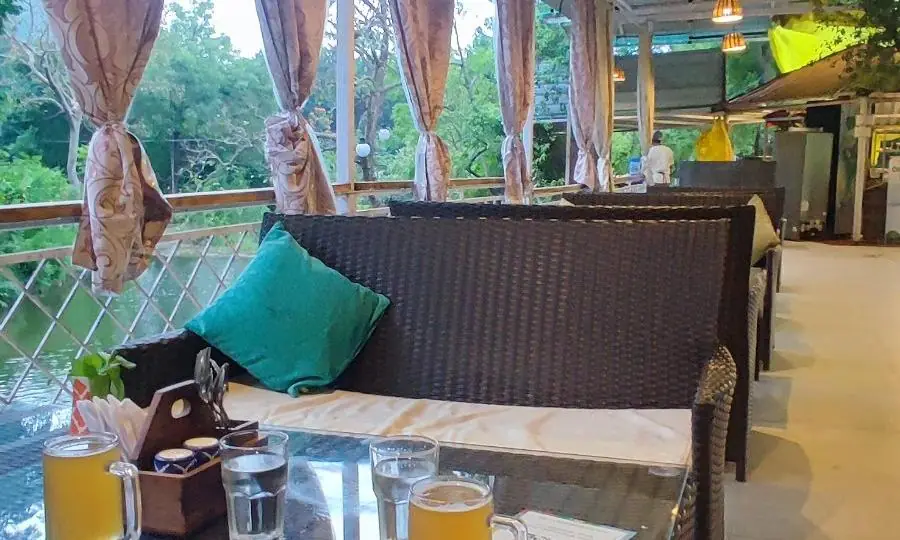
Hiranya arranges guided Ellora and Ajanta tours, and many guests use the resort as a calm base for an early start to Ajanta. It is a long day, so a quiet evening by the lake afterwards is a welcome way to let the paintings settle in the mind.