Ellora's sculptures become far easier to enjoy once you can recognise a handful of recurring subjects. The most important are Ravana shaking Mount Kailasa, Shiva as Nataraja the dancer, the river goddesses Ganga and Yamuna at shrine doorways, and the Buddha seated in the gesture of teaching. Each follows visual rules, such as a particular pose, a mount or a gesture of the hands, and once you know them you will spot them again and again across the caves.
How to read a panel
Indian sculpture uses a visual language in which each deity is identified by a few clues. Start by looking at three things.
- The pose: seated, standing, dancing, or in the middle of a fight.
- The hands: the number of arms, what they hold, and the gestures, known as mudras.
- The companions: animals, attendants and smaller figures around the main image, which often tell you the story.
Scale also matters. The main figure is usually much larger than everyone else, not because of height in real life but because of importance.
Ravana shaking Mount Kailasa
This is Ellora's signature scene, and it appears several times. The demon king Ravana, in a fit of pride, tries to lift Mount Kailasa, home of Shiva and Parvati. Shiva calmly presses down with his toe and pins Ravana beneath the mountain.
How to recognise it: look for a many-headed, many-armed figure crouched at the bottom of the panel, straining upwards. Above him, the mountain is shown as a platform where Shiva sits, often with Parvati leaning towards him in alarm while attendants cling on or flee. The contrast between the struggling demon below and the composed god above is the whole point of the scene.
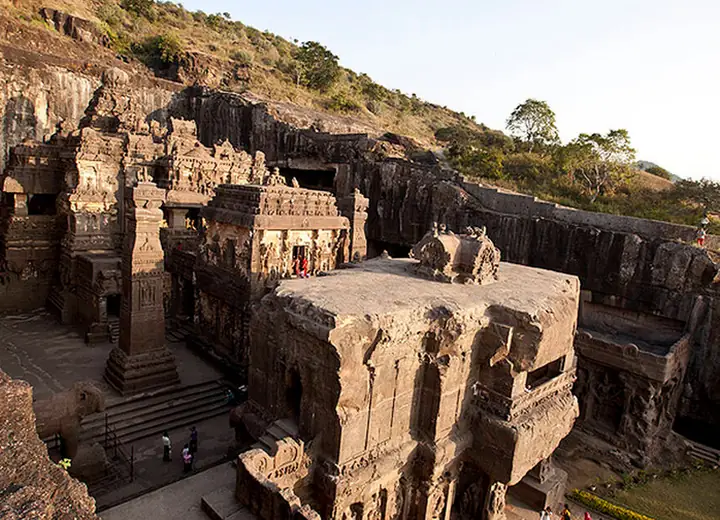
The most famous version is on the Kailasa temple (Cave 16), but you will also find it in Caves 14 and 29. Comparing them is a pleasure in itself.
Nataraja, Shiva as the dancer
Shiva dances the rhythm of creation and destruction. At Ellora, Nataraja is shown with many arms spread in a wide arc, legs bent in the movement of dance, and often a small orchestra of drummers and attendants around him.
How to recognise it: look for a figure with eight or more arms fanning out like a wheel, a lively bent posture, and small musicians at the base. Ellora's dancing Shivas are more varied and energetic than the later, standardised bronze images of South India, so do not expect the familiar ring of fire. Good examples are in Caves 14, 15, 21 and on the Kailasa temple.
Ganga and Yamuna, the river goddesses
At the entrance to many shrines stand two graceful female figures. They are Ganga and Yamuna, the sacred rivers of northern India, placed at the threshold as a sign that the visitor is purified before entering.
How to recognise them: Ganga stands on a makara, a crocodile-like water creature, and Yamuna stands on a turtle. Both are usually accompanied by small attendants, and one may hold a water pot. The finest pair at Ellora is at the entrance to Rameshwar (Cave 21), and there is also a shrine dedicated to the three rivers, including Saraswati, within the Kailasa complex.
The Buddha in teaching posture
In the Buddhist caves, the most common image is the Buddha seated in a shrine at the back of a hall. Many show him with his hands held before the chest in the dharmachakra mudra, the gesture of turning the wheel of the teaching, which recalls his first sermon at Sarnath.
How to recognise it: look at the hands, held together near the heart with fingers forming circles. Below the seat you may see a small wheel flanked by deer, a reference to the deer park where the first sermon was given. The large seated Buddha in the chaitya hall of Cave 10, known as Vishvakarma, shown in a preaching pose, is the best-known teaching image at Ellora, and the upper halls of Cave 12 contain rows of seated Buddhas.
Other figures worth knowing
- Gajalakshmi: the goddess Lakshmi seated on a lotus, bathed by two elephants pouring water. Look for it at Kailasa and in Cave 14.
- Narasimha: Vishnu as a man-lion tearing apart a demon, powerfully carved in Cave 15.
- Saptamatrikas: seven mother goddesses in a row, often with Ganesha, in Caves 14 and 21.
- Bahubali: in the Jain caves, a standing figure in meditation with vines growing around his limbs.
Hiranya is about 15 minutes from Ellora, so it is easy to return a second time with fresh eyes once you know what to look for. Our team can arrange a knowledgeable guide who will help you read the panels at your own pace.